Role of Photochemical Hazes in Planetary Habitability
How do photochemical hazes shape the climates and habitability of rocky planets, ranging from the Archean Earth to TRAPPIST-1e?
Overview
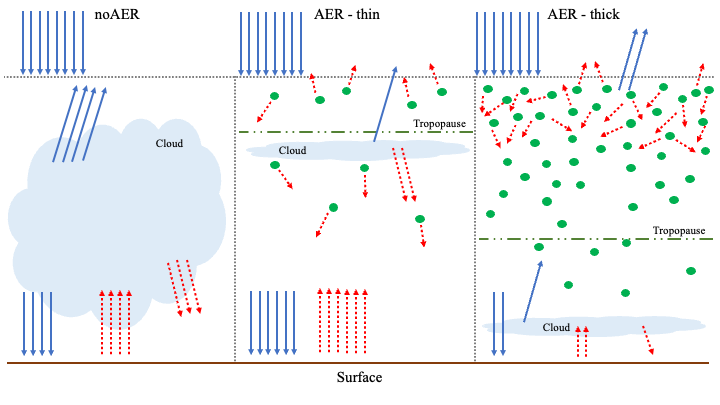
Photochemical hazes are expected to be prevalent in planets, including the Early Earth. Their presence can impact the climate through absorbing and scattering away the incoming stellar radiation, changing the energy balance within the planetary atmosphere and hence the temperature structure and circulation.
My research investigates the roles of photochemical haze in planetary climate and habitability using 3D General Circulation Model GCM, the Unified Model (UM), with a particular focus on the Archean Earth and potentially habitable rocky exoplanets.
Photochemical Hazes on the Archean Earth
Earth is currently the only planet known to harbour life. The Archean Eon (2.5 - 4 billion years ago) accounts for nearly 40% of Earth’s history, with evidence of life dating back approximately 3.8 billion years. Studying the Archean Earth is therefore crucial to understanding how life first emerged and evolved on our planet.
The atmosphere of the Archean Earth was more reducing than that of the modern Earth, which is characterised by an oxygen-rich, oxidising atmosphere. The Archean atmosphere is thought to have been dominated by gases including N2, CO2 and CH4. The presence of CH4 and CO2 would give rise to the formation of organic photochemical hazes through atmospheric photochemistry. Understanding how these gases and photochemical hazes influenced the climate of the Archean Earth is therefore essential for investigating the conditions that supported early life and assessing the potential habitability of other rocky planets.
Using 3D GCM, the UM, I investigated how prescribed photochemical haze profiles produced by the 1D photochemical model, Atmos, impact atmospheric circulation and surface temperatures. Our results showed that optically thin haze can produce surface warming through increasing the atmospheric water vapour abundance and decreasing the cloud mass fraction, while optically thicker haze can lead to substantial surface cooling, as well as inverted thermal structure due to the anti-greenhouse cooling effect. Our results have profound implications to resolving the Faint Young Sun Paradox, suggesting that a thin haze layer might have helped maintained a temperate climate despite the Earth orbiting a colder Sun during the Archean Eon.
Photochemical Hazes on TRAPPIST-1e
I extended this work to TRAPPIST-1e, a tidally-locked rocky planet orbiting an M-dwarf star.
Through three-dimensional simulations with varying CO2, CH4, and photochemical haze profiles, I investigated how atmospheric composition and haze properties influence surface temperatures and atmospheric circulation.
Our simulations showed that thin haze layers can enhance surface warming under certain conditions, while thicker haze layers generally lead to cooling.
Related Publications
The publications below provide further details of this research.
References
- 3D Simulations of the Archean Earth Including Photochemical Haze Profiles . Journal of Geophysical Research: Atmospheres , 2023 .
- 3D simulations of TRAPPIST-1e with varying CO2, CH4, and haze profiles . Monthly Notices of the Royal Astronomical Society , 2024 .